
Best Handcrafted Jewelry for Sensitive Skin: 2026 Guide
Table of Contents
- What Makes Handcrafted Jewelry Safer for Sensitive Skin
- Hypoallergenic Metals for Jewelry: What to Look For
- Signs of Jewelry Allergy: When to Stop Wearing a Piece
- Top Handcrafted Pieces for Sensitive Skin
- Caring for Handcrafted Silver Jewelry to Prevent Irritation
- How to Test Jewelry for Metal Allergies at Home
- Layering and Styling Tips for Sensitive Skin
- Frequently Asked Questions
Last Updated: September 19, 2026
What Makes Handcrafted Jewelry Safer for Sensitive Skin
The best handcrafted jewelry for sensitive skin is defined by what it leaves out. Metal allergies react to the metals a piece contains, not the design, and nickel is the most common culprit. Handcrafted makers control sourcing more tightly than mass producers, so small-batch pieces often suit reactive skin better.
"Hypoallergenic" Is a Marketing Word, Not a Legal Standard
In the United States, "hypoallergenic" has no legal definition and no enforcement behind it. No federal agency approves the term before it goes on a tag. A brand can print it on a $4 plated charm and a $4,000 platinum band alike, and neither claim is checked.
- Children's jewelry falls under Consumer Product Safety Commission rules setting strict lead and cadmium limits, because those metals are toxic at low exposure. Adult jewelry is largely exempt.
- California's Proposition 65 requires warnings on products that expose users to listed metals above set thresholds. That card is a legal disclosure, not a quality signal.
- The FTC polices false or misleading advertising generally, but keeps no list of approved jewelry terms. A maker who claims "nickel-free" and ships nickel faces a truth-in-advertising problem, not a labeling violation.
What Actually Determines Whether a Piece Is Safe
Three things matter, and none is the marketing term:
- Which metals touch your skin. The reaction is driven by direct contact, so the surface layer counts. A gold-plated brass earring exposes your lobe to brass, not gold.
- How pure the alloy is. Sterling silver is 92.5% silver; 950 sterling pushes that to 95%. Higher purity means less of the alloy metals that trigger reactions.
- Whether the piece is coated. Plating and PVD coatings seal a reactive core, but wear through at friction points, clasps, earring posts, the underside of a ring, leaving base metal against your skin.
The FDA guidance on jewelry and metal content is worth reading before you trust a label, and the CPSC children's jewelry requirements shows how much stricter the rules get once a piece is marketed to kids, a useful benchmark for how little adult jewelry is actually regulated.
Hypoallergenic Metals for Jewelry: What to Look For
The safest metals for sensitive skin are titanium, niobium, platinum, and high-purity gold or silver. What separates them is cost, weight, and finish: titanium and niobium at the practical end, platinum at the investment end.
Titanium, Niobium, and Platinum
Titanium is lightweight and strong. Niobium behaves similarly. Platinum costs more but is the most durable of the three.
Sterling Silver and Karat Gold Purity Levels
Purity is where most buyers get tripped up. Sterling silver is 92.5% silver, with the remaining 7.5% usually copper; Frijja carries higher-purity 950 sterling silver, pushing silver content to 95% and reducing the alloy portion. Karat gold works the same way: higher karat means more gold and less alloy.
| Metal | Typical Purity | Best For | Watch Out For |
|---|---|---|---|
| Titanium | Commercially pure | Highly reactive skin | Limited design options |
| Niobium | Pure | Colored pieces without plating | Narrow selection |
| Platinum | 95%+ | Long-term daily wear | High cost |
| 950 Sterling Silver | 95% silver | Everyday and statement pieces | Needs regular cleaning |
| 18K Gold | 75% gold | Warm tones, heirlooms | Still contains alloy |
Signs of Jewelry Allergy: When to Stop Wearing a Piece
Stop wearing a piece the moment you notice redness, itching, or inflammation under or around it. These classic signs of jewelry allergy appear where metal sits against skin longest: earlobes, wrists, and the back of the neck.
Watch for these:
- Redness or a raised rash confined to the metal's shape
- Itching that starts within a day of wearing
- Dry, cracked, or weeping skin
- Discoloration of the skin itself, which can signal metal transfer
Top Handcrafted Pieces for Sensitive Skin
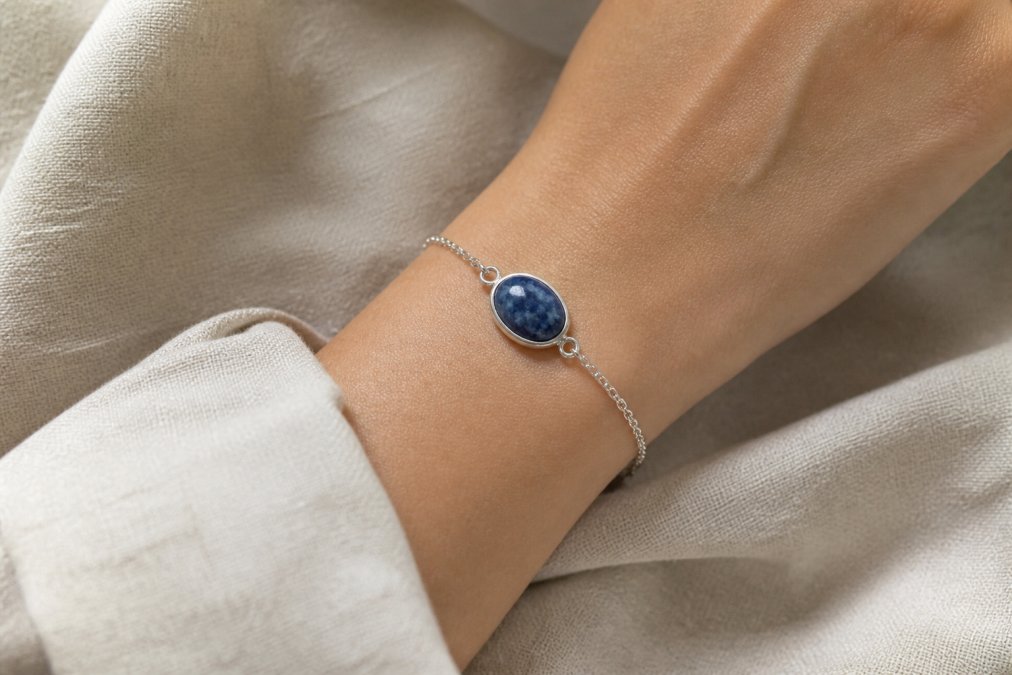
Frijja's selection leans on 950 sterling silver, which keeps the alloy portion low while still delivering the shine of fine jewelry.
Everyday Bracelets and Earrings Under $100
If you want to test how your skin responds without committing much, start here.
Statement Pieces and Gemstone Designs
Once you know silver suits you, the range opens up.
925 Sterling Silver Pearl bracelet →
| Piece | Price | Material | Best For |
|---|---|---|---|
| Black Leather Butterfly Bracelet | $18.99 | 950 silver, leather | First test piece |
| Rose Quartz Onyx Bracelet | $45.00 | 950 silver, gemstones | Casual everyday wear |
| Victorian Elegance Bracelet | $65.99 | 950 silver, sodalite | Adjustable fit |
| Moon Radiance Earrings | $68.99 | 950 silver | Pierced-ear sensitivity |
| Rainbow Gems Bracelet | $134.99 | 950 silver, mixed stones | Color and statement |
| Moon Radiance Bracelet | $256.99 | 950 silver, sodalite | Layering and gifting |
| Andean Promise Necklace | $658.99 | 950 silver, Andean opal | Investment piece |
Caring for Handcrafted Silver Jewelry to Prevent Irritation
Clean sterling silver with a soft cloth and mild soap, then dry it fully before wearing. Skip harsh dips and abrasives, which strip the surface and invite tarnish.
A few habits that prevent problems:
- Put jewelry on last, after lotion and perfume have dried
- Take pieces off before showering, swimming, or the gym
- Store silver in a dry pouch or a tarnish-resistant box
- Check clasps and settings monthly for wear
How to Test Jewelry for Metal Allergies at Home
If reactions continue across multiple nickel-free pieces, see a dermatologist for patch testing.
Layering and Styling Tips for Sensitive Skin
Layering is where sensitive-skin wearers usually run into trouble.
The Rules That Actually Prevent Reactions
- Layer solid with solid. Sterling silver against sterling silver, or gold against gold. Mixing a solid piece with a plated costume piece makes the plated one the weak link, and it will fail first.
- Leave a gap between bracelets. Metal-on-metal contact abrades finishes and accelerates wear-through where your skin is most exposed. A quarter-inch of clearance is enough.
- Put the heaviest piece closest to the skin. Friction is lowest there, so the piece that moves least does the least damage.
- Rotate rather than stack daily. The same stack worn every day concentrates wear on the same contact points. Rotating spreads it out and extends the life of every piece.
- Mind the clasp. Clasps and hooks are often a different alloy than the body of the piece. If you react at the back of your neck or the inside of your wrist, the clasp is the first suspect, not the chain.
Texture, Finish, and Mixing Metals Without Irritation
Texture is your friend here. A smooth 950 silver band next to a beaded bracelet creates contrast without metal-on-metal grinding. Mixing finishes, matte next to polished, hammered next to smooth, works too, as long as every piece is solid rather than plated; the visual interest comes from the finish, not a coating that will wear off. Mixing metals is also fine for most sensitive-skin wearers, with one caveat: reaction risk comes from the alloy, not the color.
Styling for Pierced Ears
Ears are a common site for jewelry reactions, and styling matters as much as metal choice:
- Stick to studs and button styles on high-rotation days. Dangling earrings pull on the lobe, and that constant movement sets off earlobe sensitivity faster than a static stud will.
- Match post material to the piece. A titanium post in a sterling earring is a common, sensible combination, the post sits inside the piercing, so it matters most.
- Give new piercings time. A healing piercing is more reactive than a fully healed one, so introduce new metals slowly.
- Take earrings out before bed. Overnight pressure against a pillow traps heat and moisture against the lobe, a common trigger even for otherwise-safe metals.
Frequently Asked Questions
What is the best jewelry material for sensitive skin?
Titanium, niobium, platinum, and 950 sterling silver are among the best choices for sensitive skin. These metals are non-reactive and resist corrosion, reducing the chance of redness or itching. Surgical stainless steel is another option, though it can contain trace nickel. Always check for nickel-free and lead-free labels. Handcrafted jewelry often uses higher-purity metals like 950 silver, which contains less copper alloy than standard 925 sterling silver, making it a safer bet for reactive skin.
What metals should I avoid if I have a nickel allergy?
Avoid nickel, lead, and cadmium. Nickel is the most common trigger for contact dermatitis. It appears in many base metals, gold plating, and some stainless steel. Lead and cadmium are toxic and can cause severe reactions. Look for jewelry labeled nickel-free and cadmium-free. PVD coating can seal a base metal, but once it wears off, the underlying metal may irritate. Handcrafted pieces from reputable artisans typically disclose their metal content clearly.
How can I tell if jewelry is truly hypoallergenic?
Check for specific metal purity marks like 950, 925, or 999 for silver, and 14K or 18K for gold. Terms like 'hypoallergenic' are not regulated in the U.S., so they can be misleading. A true hypoallergenic piece should be nickel-free, lead-free, and cadmium-free. Ask the seller for material certifications. For handcrafted jewelry, artisans often provide detailed sourcing information. If a piece is plated, ask about the base metal and coating thickness.
Why does sterling silver sometimes irritate sensitive skin?
Sterling silver is an alloy, usually 92.5% silver and 7.5% copper. The copper can cause reactions in people with metal sensitivities. However, higher-purity sterling silver like 950 contains less copper, reducing irritation risk. Tarnish and buildup from lotions or sweat can also trigger redness. Regular cleaning with a soft cloth and storing pieces in a dry place helps prevent reactions. If irritation persists, switch to titanium or niobium, which are biocompatible and non-reactive.
Is handcrafted jewelry better for sensitive skin than mass-produced pieces?
Handcrafted jewelry often uses higher-purity metals and avoids cheap base metals like nickel and lead. Artisans typically disclose their materials and can customize pieces for allergies. Mass-produced jewelry may use unknown alloys or thin plating that wears off quickly, exposing irritants. Handcrafted pieces from brands like Frijja use 950 sterling silver, which is more biocompatible. However, always verify the metal content regardless of how the jewelry is made. Quality craftsmanship and clear material sourcing matter most.