

Table of Contents
- Visual Inspection: The Foundation of Spotting Fake Antique Decor
- Signs of Machine-Made vs Handmade Decor
- Hardware, Fasteners, and Age-Related Clues
- Material Verification: Period-Correct vs Modern Materials
- Antique Appraisal Tools and Digital Authentication
- Common Antique Decor Scams and Red Flags
- Building Your Authentication Checklist
- Frequently Asked Questions
Last Updated: September 24, 2026
Visual Inspection: The Foundation of Spotting Fake Antique Decor
To spot fake antique decor, examine wear patterns, patina, and surface changes that modern reproductions struggle to replicate.
Authentic pieces display uneven wear matching their use history, high-traffic areas show more damage, shelves have distinct marks. Fake pieces look uniformly aged, as if distressing was applied equally to every surface.
Real wood develops a smooth, slightly waxy feel from decades of handling. Modern finishes feel too plastic or too rough. Metal patina should be uneven, with deeper oxidation in crevices.
Examining wear patterns and patina
Wear patterns tell a story: finish wears thin where hands rest, cabinet edges show repeated use, chair legs wear unevenly. Reproductions have wear that looks applied rather than earned.
Patina is a chemical change in the surface that develops unevenly, deeper in corners where moisture collected, lighter on sun-exposed surfaces. Fake patina looks painted on or artificially stained.
Old wood shows checking (small cracks following the grain naturally), which develops as wood loses moisture. Modern staining can't replicate this convincingly.
Checking wood grain, joinery, and construction
Hand-crafted joinery is a clear sign of authenticity. Machine-made dovetails are perfectly uniform; hand-cut dovetails vary slightly in size and spacing with visible, irregular saw marks.
Old furniture uses wrought nails with irregular shapes. Modern nails are perfectly uniform, perfectly round, evenly spaced holes indicate a newer piece.
Authentic period pieces use woods available during their era, mahogany, walnut, and oak in American furniture. Reproductions substitute plywood or veneers. Check underside and interior surfaces for matching wood quality.
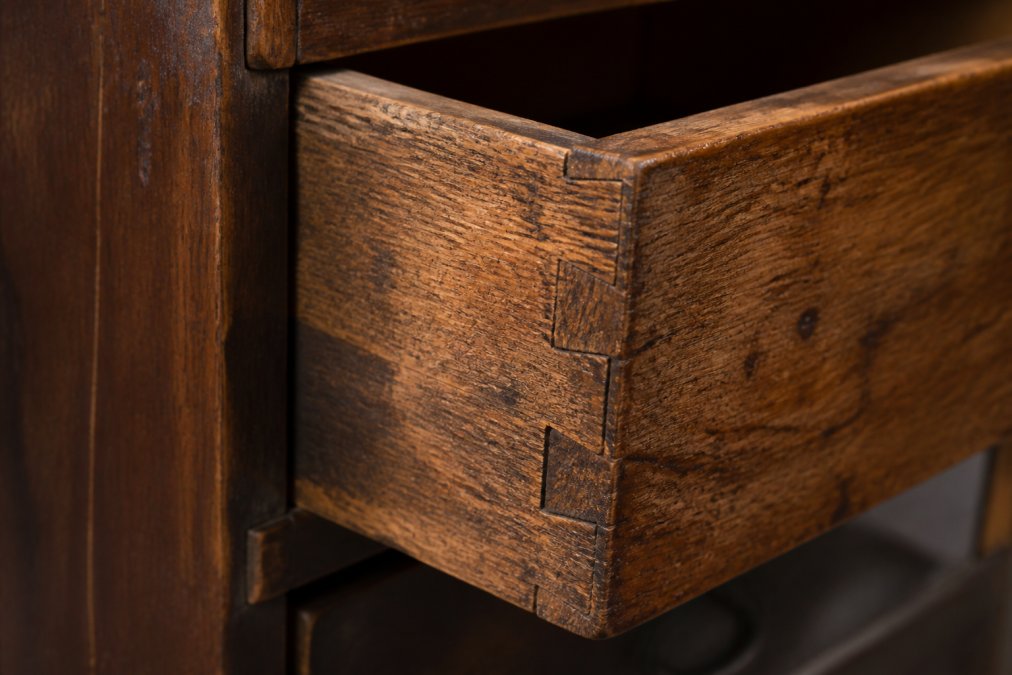
Signs of Machine-Made vs Handmade Decor
Handcrafted pieces show variation; machine-made pieces show perfection.
Tool marks and hand-finished details
Hand tools create slightly uneven surfaces and edges; surfaces show the rhythm of hand work with variations that never exactly match. Machine tools create uniformity, perfect curves, smooth surfaces, and identical holes.
Handmade edges are slightly rounded; machine-made edges are sharp or uniformly beveled. Authentic carved details show tool marks and variations; fake carvings look too smooth and perfect.
Hand-applied finishes have slight color and thickness variations with visible brush marks. Machine-applied finishes are perfectly even, a red flag for authenticity.
Consistency and precision differences
Handmade items vary slightly, drawer pulls differ in size, legs have minor diameter variations. Reproductions overcorrect with obvious or too-regular variations. Measure key dimensions: identical measurements indicate machine production.
Hardware, Fasteners, and Age-Related Clues
Hardware ages in distinctive ways. Screws, nails, and drawer pulls reveal the truth about a piece's age and origin.
Screws, nails, and drawer pulls
Hand-forged screws from the 1800s have irregular slots and slightly off-center heads. Flat-head screws came after the 1830s; Phillips-head screws didn't exist before 1936. Finding Phillips-head screws in a piece claimed to be from the 1800s indicates a reproduction.
Wrought nails (before 1880) are hand-forged with square or rectangular shape. Cut nails (1880-1920) are flat with tapered sides. Wire nails came later. Wrong nail types indicate fakes.
Hardware should match the claimed period. Brass develops specific patina; iron rusts characteristically. Reproduction hardware looks too shiny or uniformly aged.
Material Verification: Period-Correct vs Modern Materials
Materials reveal secrets. Authentic antiques use materials available during their era. Modern materials in an old piece are a red flag.
Wood species and finish types
American walnut was common in 1800s furniture; oak in the early 1900s; mahogany in high-end pieces. Cheap reproductions use whatever wood is affordable today.
Shellac (pre-1920s) creates warm, amber appearance; lacquer came later; polyurethane is modern. Polyurethane on 1800s pieces indicates refinishing or fakery. Test: shellac dissolves in alcohol, rub a hidden area with alcohol-dampened cloth.
VALENTINE LOVE SHACK WOOD METAL BIRD →
Ceramics, glass, and spelter identification
Old ceramics have uneven glaze with crazing (hairline cracks); reproductions have perfect glaze. 1800s glass has tiny bubbles and imperfections; modern glass is too clear. Real spelter develops distinctive patina and corrodes differently than cheap pot metal.
Antique Appraisal Tools and Digital Authentication
Physical inspection tools and digital resources confirm age, materials, and construction methods.
Physical verification tools and techniques
A magnifying loupe (10x magnification) reveals details invisible to the naked eye. Use it to inspect:
- Saw marks inside joints: Hand-cut dovetails show irregular, slightly curved saw marks. Machine-cut joints display perfectly parallel, evenly spaced marks. The variation in depth and angle is the key, hand tools create natural inconsistency.
- Finish layers: Look at any scratches or worn edges. Authentic old finishes show multiple layers of different colors or sheens as they wear through. Modern single-coat finishes wear uniformly. Shellac finishes often show a warm amber tone under magnification; polyurethane appears plastic-like and uniform.
- Wood grain and checking: Magnification reveals whether cracks follow the wood grain naturally or appear artificially created. Real checking develops along the grain's natural structure; fake distressing often crosses grain lines.
UV light reveals repairs and refinishing invisible in normal light. Shellac and lacquer glow blue or purple; polyurethane produces different patterns. Refinished or repaired areas show color variations, revealing replaced sections, filled cracks, or touch-up work.
A digital microscope (20x-200x magnification) documents tool marks in carved details, patina consistency, finish layering, and metal corrosion patterns, useful for sharing with appraisers on significant purchases.
Using online databases and maker marks
Maker marks are signatures on pieces. Online databases catalog these marks, search the mark to learn who made the piece and when. Porcelain makers like Theodore Haviland marked pieces distinctively. Exact matches confirm authenticity; slight variations in mark placement are normal from hand-stamping.
Provenance documentation matters.
Chemical testing and professional verification
Professional appraisers use X-ray fluorescence (XRF) to identify metal composition and thermoluminescence dating to confirm ceramic age. Request these tests for significant purchases. Reputable sellers cooperate; those who refuse are a red flag.
Common Antique Decor Scams and Red Flags
Some sellers deliberately create fakes. Others misrepresent newer pieces as older. Knowing the common scams and platform-specific tactics protects you.
Online marketplace warnings and platform-specific red flags
eBay-specific red flags:
Watch for eBay listings ending in 1-2 hours with no bids, sellers rush buyers past authentication. Legitimate dealers use 7-day windows. Check seller feedback: new sellers (under 50 transactions) with antiques should raise suspicion. If a seller lists 50 items weekly, they're likely selling bulk reproductions. Legitimate sellers show multiple angles, maker marks, and construction details. Request additional photos; refusals indicate concealment.
Etsy-specific red flags:
Facebook Marketplace and local sales red flags:
Pricing tells a story
Genuine antiques cost more than reproductions. If the price seems too good to be true, it probably is. Real antique dealers price based on age, rarity, condition, and provenance. If the price seems too good to be true, it probably is. Real antique dealers price based on age, rarity, condition, and provenance.
Provenance documentation and authenticity claims
Provenance is the documented history of ownership. Real antiques have paper trails. Estate sales, auction house records, and previous ownership documentation all build provenance.
Ask sellers for:
- Previous ownership documentation (receipts, auction catalogs, estate sale records)
- Repair or restoration records
- Photographs showing the piece in previous collections
- Expert appraisals from certified appraisers
Building Your Authentication Checklist
Use this systematic approach every time you evaluate a piece.
| Verification Step | What to Check | Red Flag |
|---|---|---|
| Visual wear | Uneven patina, natural wear patterns | Uniform aging, painted distressing |
| Wood/materials | Period-correct species, original finish | Modern materials, perfect condition |
| Construction | Hand-cut joints, irregular tool marks | Machine precision, modern fasteners |
| Hardware | Appropriate to era, natural patina | Shiny, uniform, wrong fastener type |
| Maker marks | Identifiable, verifiable | Unclear, unknown, missing |
| Provenance | Documentation, ownership history | No records, vague origins |
| Price | Reflects age and rarity | Suspiciously cheap |
Frequently Asked Questions
How can I tell if an antique is authentic without professional appraisal?
Start with visual inspection: examine wear patterns, patina, and joinery for signs of age. Check hardware for period-correct fasteners and oxidation. Compare wood grain and finish against known examples of the era. Cross-reference maker marks or signatures in online databases. Look for hand-finished details and tool marks that indicate handmade construction. While these methods help spot obvious reproductions, valuable pieces benefit from professional appraisal to confirm authenticity and establish provenance.
What are the main differences between signs of machine-made vs handmade decor?
Handmade pieces show irregular spacing, slight imperfections, and visible tool marks from hand tools. Machine-made items display perfect symmetry, consistent precision, and uniform patterns. Handmade wood furniture often has uneven joinery and hand-carved details with natural variation. Machine-made pieces use identical dovetail cuts and molded components. Examine drawer bottoms, undersides, and interior surfaces where craftspeople were less concerned with appearance. Handmade ceramics show subtle variations in glaze and thickness, while machine-made pottery has uniform coating and wall thickness throughout.
What common antique decor scams should I watch for online?
Beware of sellers claiming 'vintage-style' or 'reproduction' as authentic antiques. Watch for vague descriptions lacking specific dates, maker information, or provenance. Red flags include suspiciously low prices for rare items, photos with poor lighting or angles that hide flaws, and sellers unable to answer detailed questions about construction or materials. Avoid listings with stock photos or images copied from other websites. Request detailed provenance documentation and certificates of authenticity. Verify seller credentials and read reviews carefully. Never buy expensive pieces without professional authentication or inspection guarantees.
How do I verify provenance and authenticity for antique home decor?
Request documentation including original purchase receipts, auction house records, or appraisal certificates. Research maker marks, signatures, or hallmarks using online databases and antique reference guides. Contact museums or historical societies specializing in the item's era or style. Examine labels, stamps, or inscriptions on the piece itself. Ask sellers for the item's ownership history and how they acquired it. For valuable pieces, hire a certified appraiser through the American Society of Appraisers. Cross-reference construction techniques and materials against period-appropriate standards to confirm the item matches its claimed age and origin.
0 Kommentare