

Table of Contents
- Start With the Clues You Can See
- Vintage Jewelry Hallmarks Guide: Decoding Stamps and Maker's Marks
- How to Test Gold Jewelry at Home Without Damaging It
- Identifying Vintage Costume Jewelry vs. Fine Pieces
- Spotting Modern Fakes and Reproductions
- When to Call in a Professional Appraiser
- Caring for Your Vintage Finds
- Frequently Asked Questions
Last Updated: September 6, 2026
Authentic vintage jewelry holds a unique appeal, carrying decades of craftsmanship and history in every clasp and setting. Yet the market is flooded with reproductions, and learning how to identify authentic vintage jewelry is the first skill any collector or fashion lover should master. Below are the practical clues that separate genuine treasures from clever fakes.
Start With the Clues You Can See
The fastest way to spot authenticity is to look before you magnify. Authentic vintage jewelry shows natural signs of age: micro-scratches on high points, softened edges on prongs, and subtle wear patterns. A genuine piece from decades past will rarely look factory-fresh, so uniform shine or crisp detailing can signal a modern reproduction.
Check the clasp and hinges first, as these endure the most stress. Older pieces often feature barrel clasps, box clasps with safety chains, or hook-and-eye mechanisms that feel substantial. Modern fakes typically use lightweight spring rings or stamped components that lack that heft.
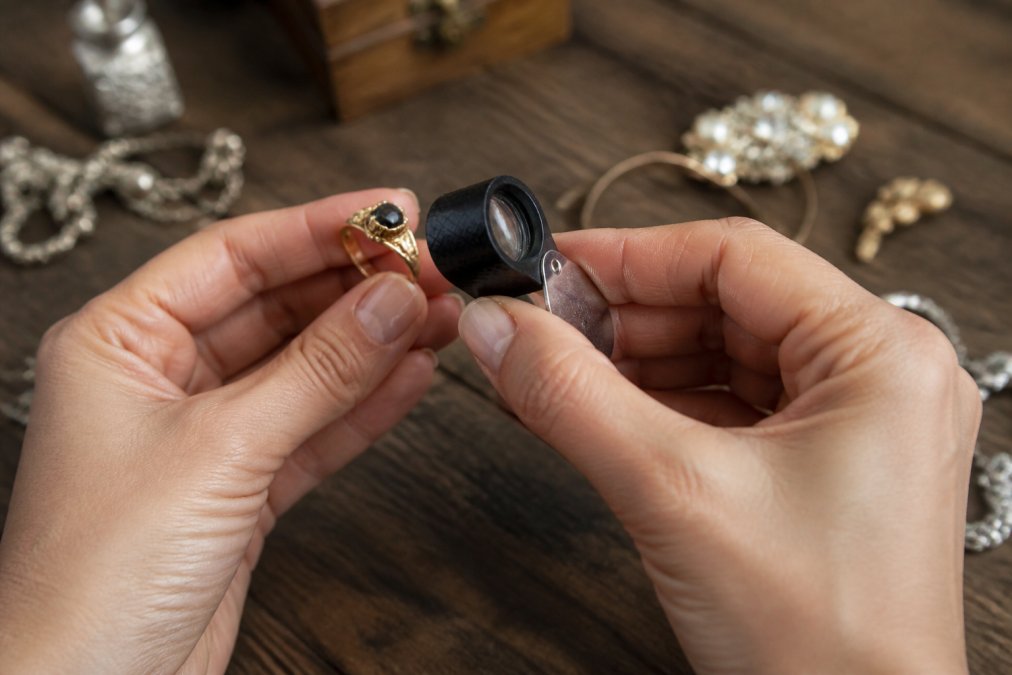
The patina tells its own story. Genuine sterling silver develops a warm, even tarnish over time, while gold shows gentle wear rather than flaking. If a piece labeled as gold is peeling or showing a different color underneath, you are likely looking at gold plating over a base metal, a hallmark of costume jewelry rather than fine vintage pieces.
Vintage Jewelry Hallmarks Guide: Decoding Stamps and Maker's Marks
Hallmarks are the jewelry equivalent of a fingerprint, but reading them requires understanding the system behind the stamp. This guide goes beyond '925' and '14K' to give a practical framework for decoding what you see under your loupe.
The Purity Mark: More Than Just a Number
The purity mark tells you the metal content, but the format reveals the era. Before 1906 in the U.S., gold pieces often carried no mark or used terms like '18ct' or 'Fine Gold.' After the National Stamping Act of 1906, marks like '14K' and '18K' became standardized. A '14KP' mark, 'P' for plumb, guarantees at least 14 karats and dates primarily from the 1970s onward; a '14K' without the 'P' could legally be slightly under karat in older pieces. For silver, 'Sterling' or '925' indicates 92.5% silver, while 'Coin' or '800' indicates 80% silver, common in European pieces but rare in American vintage. A 'copyright' symbol (circled C) next to a maker's mark strongly indicates a post-1955 piece.
Maker's Marks: The Designer's Signature
The maker's mark is your key to provenance. American manufacturers and designers registered their marks with the U.S. Patent and Trademark Office; Tiffany & Co. has used variations of 'T&Co.' since 1837. A piece marked 'Coro' or 'Trifari' is costume jewelry, while 'Tiffany & Co.' or 'Cartier' is fine jewelry. The font, spacing, and surrounding symbols all matter. A common counterfeit tactic is stamping a known designer's name onto base metal. Under 10x magnification, genuine marks are crisp and evenly struck, while fake stamps often appear shallow, uneven, or blurry because they were applied after casting rather than during die-striking.
Date Letters and Assay Office Marks
While the United States never mandated date letters, many high-end American pieces from the late 19th and early 20th centuries followed the British convention, especially if the maker was trained in Europe. British hallmarks are the most complex and informative. A full British hallmark set includes: a maker's mark, a purity mark (like '.925' or a lion passant for sterling), an assay office mark (a leopard's head for London, an anchor for Birmingham, a crown for Sheffield), and a date letter. The date letter is a single letter in a specific font and shield shape, changing annually. For example, a lowercase 'a' in a specific shield might indicate 1901, while an uppercase 'A' in a different shield might indicate 1926. Decoding these requires a reference chart, which you can find in the Encyclopedia of Silver Marks, a comprehensive free database.
The Limits of Hallmark Reading
A hallmark is evidence, not proof. Modern counterfeiters stamp convincing '14K' marks onto gold-plated tungsten or brass. Always cross-reference the hallmark with construction clues: weight, wear patterns, and clasp type. If a piece has a 'Tiffany & Co.' mark but a lightweight, hollow feel and a modern spring-ring clasp, the mark is likely fake. Conversely, a genuine vintage piece with a worn, partially obscured hallmark is often more trustworthy than a pristine one, because the wear pattern is consistent with decades of use.
A Practical Decoding Workflow
- Locate the mark using a 10x loupe. Check the inside of the band, the back of a brooch, the tongue of a buckle, or the underside of a clasp.
- Photograph it with a macro lens or a phone camera zoomed to 3x or higher.
- Identify the purity mark first (e.g., '925', '14K', 'PT950').
- Identify the maker's mark by comparing the font and symbols against a database.
- Check for a date letter or assay office mark if the piece has a British-style hallmark.
- Cross-reference the hallmark with physical clues (weight, wear, clasp style).
- If the mark is unfamiliar, do not assume it is fake. Many small American manufacturers operated for only a few years and left little documentation. An unfamiliar mark is a reason for further research, not a reason to reject the piece outright.
Mastering hallmark reading develops with practice. Start by examining pieces you already own, photographing every mark, and building your own reference library. Over time, you will spot a genuine mark from a fake at a glance.
How to Test Gold Jewelry at Home Without Damaging It
Testing gold at home is possible, but caution is critical. The safest approach starts with the magnet test: genuine gold and sterling silver are not magnetic, so a strong pull toward a magnet indicates a base metal core. This is a screening test only, not proof of purity.
The most reliable home method is the acid test, which uses a scratch stone and testing acids of known karat strengths. Rub the piece on the stone to leave a trace, then apply acid; the reaction reveals the karat. This method scratches the surface, so reserve it for inconspicuous areas. For plated items, an acid test can cut through the plating and expose the base metal, informative but damaging.
Identifying Vintage Costume Jewelry vs. Fine Pieces
Costume jewelry and fine jewelry occupy opposite ends of the value spectrum, and identifying vintage costume jewelry requires a different lens than assessing fine pieces. Costume pieces were made with non-precious materials: base metals, glass stones, and gold plating or vermeil (gold over sterling silver). Their value lies in design, brand recognition, and historical significance rather than material content.
Fine vintage jewelry, by contrast, uses precious metals and genuine gemstones. Weigh the piece in your hand; fine jewelry feels denser. Examine the gemstone setting: a bezel that holds a stone snugly with clean edges suggests professional craftsmanship, while glued stones or prongs that catch on fabric point to costume construction. The clasp is another tell, fine pieces have secure, well-engineered clasps, whereas costume jewelry often relies on simple friction or spring mechanisms.
| Clue | Fine Vintage Jewelry | Costume Jewelry |
|---|---|---|
| Metal | Precious (gold, platinum, sterling) | Base metal, gold plating, vermeil |
| Stones | Genuine gemstones | Glass, plastic, rhinestones |
| Weight | Dense and substantial | Lightweight |
| Clasp | Secure, engineered | Simple, spring-based |
| Hallmarks | Karat or purity stamps | Often none or "copyright" only |
Spotting Modern Fakes and Reproductions
The 'vintage-style' market has exploded in the last decade, and understanding its structure is your first line of defense. This is about mass-produced pieces engineered to mimic the look of a 1920s heirloom. The most common source is the bridge-jewelry sector: brands that cast 'antique-inspired' pieces in bulk using modern lost-wax casting, often with a brass or copper base plated with rhodium, gold, or silver. They are sold at mall kiosks, on flash-sale sites, and on social media marketplaces, where descriptions lean heavily on words like 'vintage style' or 'estate-inspired.'
Your first test is the hallmark, but not for the reason you think. A genuine vintage piece from a major manufacturer like Napier, Trifari, or Weiss will carry a specific, registered mark. A modern reproduction will either carry no mark at all, a generic 'copyright' symbol, or a mark that mimics a known designer but is slightly off, wrong font, wrong spacing, or a misspelling. Use a 10x jeweler's loupe to read the mark critically. Compare it against a known hallmark database, such as the one maintained by the International Gem Society, which catalogs thousands of maker's marks with images.
Next, examine the 'cast vs. stamped' tell. True vintage fine jewelry was often stamped or hand-fabricated, producing sharp, crisp edges and uniform thickness. Casting, the method of choice for modern reproductions, leaves microscopic porosity, tiny pits, on the surface, and details can look rounded or 'soft' as the metal shrinks. Run your fingernail along a filigree edge: a stamped piece feels clean and sharp, while a cast reproduction feels smooth or shows a slight ridge where the mold halves met.
A second, more insidious fake is the 'marriage' piece: a genuine vintage setting, say, a 1940s sterling brooch base, stripped of its original stones and re-set with modern, machine-cut cubic zirconia or low-grade synthetics. The metal and hallmark are authentic, but the piece is no longer original. Under magnification, genuine old stones were cut with hand-guided wheels, producing slightly irregular facet junctions and softer sparkle, while modern machine-cut stones have perfectly symmetrical facets and sharp, rainbow-like fire. Also check the prongs: if pristine, with no tool marks or wear, they were likely re-tipped recently, a red flag that the piece has been altered.
Finally, use the 'smell and weight' test. Modern base-metal reproductions often have a faint metallic, coppery odor after being worn; genuine sterling silver and gold are odorless. Because modern reproductions use hollow or thin-walled castings, they feel noticeably lighter than a solid vintage piece of the same size. Compare it to a known solid vintage piece, the difference is often dramatic.
If buying online, ask the seller for a macro photograph of the hallmark and clasp. Legitimate vintage dealers will provide these without hesitation; if they refuse or send a blurry image, treat it as a warning sign. The modern fake market relies on the buyer not looking closely, your loupe is your best defense.
When to Call in a Professional Appraiser
Home inspection has limits. If you suspect a piece is valuable, have found a designer signature, or the hallmark is unfamiliar, a professional appraisal is the right call. A certified appraiser uses advanced tools, including electronic testing and spectroscopy, to determine metal content and gemstone identity without damaging the piece.
Appraisals serve two distinct purposes: insurance valuation and authentication. An insurance appraisal documents replacement value, while a written authentication provides provenance and confirms age and origin. The American Gem Society maintains a directory of certified appraisers who follow strict ethical standards. For estate pieces or inherited jewelry, professional authentication also helps you understand the piece's history before you decide to wear, insure, or sell it. Digital authentication tools, including magnified photography and online hallmark databases, can supplement but not replace a trained eye.
Caring for Your Vintage Finds
Once you have confirmed authenticity, proper maintenance preserves both beauty and value. Store pieces individually in soft pouches or lined boxes, and keep sterling silver in anti-tarnish strips to slow oxidation. Gold and platinum are more resilient but still benefit from separate storage.
Clean your vintage pieces gently. A soft brush with mild soapy water works for most metals, but avoid ultrasonic cleaners for pieces with glued stones, enamel, or delicate filigree, as the vibration can loosen components. For intricate pieces, a professional cleaning is safer than home methods. The Gemological Institute of America recommends professional inspection annually to check prongs, clasps, and settings for wear, ensuring your treasure remains secure and wearable. Regular care not only keeps your jewelry beautiful but also protects the craftsmanship that makes it authentic.
Authentic vintage jewelry rewards the patient eye, and the skills to identify it are learned through practice, not luck. Start with visible clues, decode the hallmarks, and test carefully before you buy. For pieces that resist your best efforts, a professional appraiser provides the certainty you need. At Frijja, we celebrate craftsmanship in every handcrafted piece we offer, from sterling silver designs to limited antiques, and we invite you to explore a collection where quality and authenticity are always in fashion.
Frequently Asked Questions
How can you tell the difference between vintage and antique jewelry?
Age is the main difference. Antique jewelry is at least 100 years old, while vintage pieces are typically 20 to 99 years old. A piece from the 1920s is antique; one from the 1970s is vintage. This distinction matters for value and rarity. Antique pieces often show more handcrafted details and older hallmarks, but both categories can be authentic and collectible.
What hallmarks should I look for on vintage jewelry?
Look for purity stamps like 14k, 18k, 925, or 950 for platinum. Also search for maker's marks, designer signatures, and assay office symbols. A vintage jewelry hallmarks guide helps you decode these stamps and date letters. If you see 'Sterling' or a karat mark, the piece uses precious metal. The absence of marks doesn't always mean fake, but it warrants closer inspection.
Is there a free app to identify vintage jewelry?
Yes, some apps help with initial research. Google Lens can search for similar pieces and designer signatures. There are also jewelry identification apps that use image recognition. Use these tools to get a starting point, but remember they are not infallible. For authentication, always cross-check your findings with a physical inspection and a professional appraiser.
How to test jewelry at home to see if it's real gold?
Start with the magnet test. Real gold is not magnetic, so if the piece sticks, it contains base metal. Then, examine the piece under bright light for wear patterns. Look for discoloration on the edges, which suggests gold plating over base metal. An acid test kit can confirm, but use it on a hidden spot. Always read the instructions carefully to avoid damaging the jewelry.
0 Kommentare